Cot vs air mattress vs sleeping pad
- Coleman Trailhead II Large Folding Cot
 Coleman Trailhead II Large Folding Cot with Easy Setup & Takedown$54.99Check priceSpec sheet
 - Hikenture 4" Thick Self Inflating Sleeping Pad
 Hikenture 4" Thick Self Inflating Sleeping Pad$85.49Check priceSpec sheet
The short verdict
- Buy a cot if ground moisture, bugs, or an uneven tent floor are the bigger problem, and pair it with an insulating pad on top for cold nights.
- Buy an insulated sleeping pad if warmth per pound and packed size matter, or if you are sleeping in the back of the car where a cot does not fit.
| Folding cot | Air mattress (typical queen) | Insulated sleeping pad | |
|---|---|---|---|
| Example price | $54.99 (Coleman Trailhead II) | Typically $30 to $80 for a queen | $85.49 (Hikenture, R9.5) |
| Off-ground height | About 15 to 18 in, fully off the ground | Sits directly on the tent floor | Sits directly on the tent floor |
| Typical insulation (R-value) | No insulation of its own; add about R 1 loss from moving air underneath | About R 1 or less uninsulated; feels cold below roughly 50F | R 2 to R 9+ depending on model |
| Comfort on uneven ground | Best; the frame ignores rocks and roots below it | Good if fully inflated; sags on uneven ground | Fair; thickness helps but ground contours still come through |
| Packed size | Large and rigid; takes real trunk space | Bulky when packed but compresses somewhat | Compact; rolls or folds small |
| Setup effort | A few minutes to unfold and lock the frame | A few minutes with an electric or battery pump | A few minutes to unroll and let it self-inflate, or a quick top-off by mouth |
What is actually different about a cot, an air mattress, and a sleeping pad?
A cot is a rigid frame that lifts you entirely off the tent floor, which solves ground moisture and uneven terrain but does nothing for insulation on its own. An air mattress is a large air-filled cushion that sits on the tent floor and prioritizes comfort and surface area over insulation. A sleeping pad, especially a self-inflating or closed-cell foam pad, is built specifically around the R-value scale to trap body heat against the ground. Start with the tent size calculator to confirm your tent has room for whichever setup you choose, since a cot and a queen air mattress both need real floor space.
Why does a cot need a pad on top of it?
Lifting the sleeper into moving air underneath the cot actually costs about R 1 of insulation compared to sleeping directly on the ground, since air circulates freely beneath the fabric. A bare cot in cold weather can feel colder than the ground itself for that reason. The fix is simple: add an insulated pad or a closed-cell foam layer on top of the cot. R-values add when stacked, so a cot plus an R 4 pad performs roughly like an R 3 setup once you account for the underside air loss. Check your expected overnight low against the sleeping pad R-value chart before picking a pad.
How cold is too cold for a plain air mattress?
A standard uninsulated air mattress insulates poorly, roughly R 1 or less, and most people start feeling the cold coming up through it once the ground or ambient temperature drops below about 50F. This is the single most common car camping mistake: bringing a queen air mattress meant for guest rooms and being cold all night despite a warm sleeping bag, because the bag cannot fight heat loss happening underneath. A foam pad or blanket layered under an air mattress fixes this cheaply. See do you need a sleeping pad for the full explanation.
Which setup is most comfortable for two adults?
A queen air mattress wins on raw comfort and surface area for a couple, assuming the ground underneath is flat and the temperature stays above roughly 50F. Two cots pushed together or two wide sleeping pads work better once cold weather or an uneven site is in play, since a queen mattress that partially deflates overnight or sags into a rut is a common complaint.
Can you combine these instead of choosing just one?
Yes, and many experienced car campers do. A cot with an insulated pad on top gets both the off-ground clearance and the R-value warmth. A sleeping pad under a queen air mattress adds a warmth floor while keeping the air mattress's comfort. The right combination depends on your expected overnight low; walk through it on the sleeping pad R-value calculator.
Other options on both sides
 TaskStar 4" Self Inflating Sleeping Pad for Camping with Pillow$49.99Check priceSpec sheet
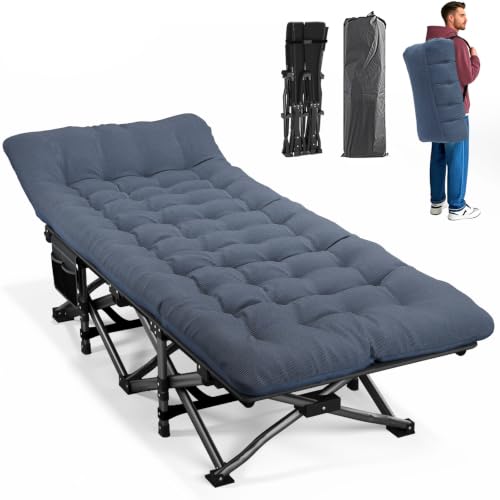 ATORPOK Camping Cot for Adults with Comfortable Cushion$79.99Check price
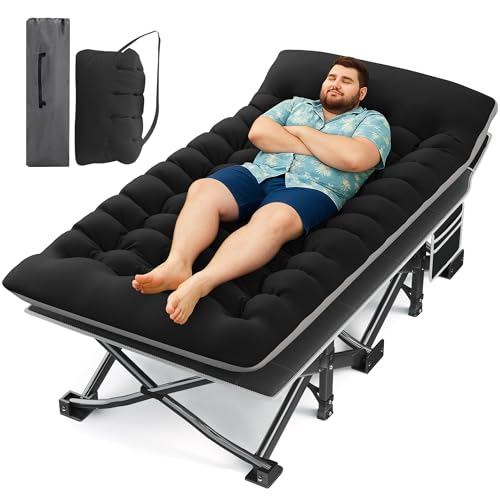 HABUTWAY Camping Cot with Mattress$129.99Check priceSpec sheet
 Elegear Self Inflating Sleeping Pad with Electric Pump 3.15" Memory$159.99Check price
 Therm-a-Rest MondoKing 3D Self-Inflating Camping Sleeping Pad$259.95Check priceSpec sheet
 Exped MegaMat Sleeping Pad$449.95Check price
Keep planning
Frequently asked questions
Is a cot warmer or colder than sleeping on the ground?
Colder, by itself. Lifting a sleeper into moving air underneath a cot costs roughly R 1 compared to lying directly on the ground, since air circulates freely beneath the fabric and pulls heat away faster. A cot needs an insulated pad or foam layer on top to perform as well as ground sleeping in cold weather.
Can I use a regular home air mattress for car camping?
You can, but a standard uninsulated air mattress only insulates to roughly R 1 or less and will feel cold below about 50F overnight. It works fine in warm weather but needs a foam pad or blanket underneath once temperatures drop into the 40s or lower.
Do sleeping pad R-values actually add up when stacked?
Yes. R-values are additive, so a foam pad under an inflatable pad, or a pad on top of a cot, combines close to the sum of their individual R-values. This is the standard way to boost warmth for a specific overnight low without buying a single higher-R pad.
Which is easiest to pack in a small car?
A sleeping pad, by a wide margin. Most self-inflating and foam pads roll or fold into a fraction of the space a folding cot frame or a queen air mattress takes up, which matters more in a sedan or hatchback than in a full-size SUV.
Do I need a cot if I already have a thick sleeping pad?
Not necessarily. A thick, high-R sleeping pad solves the warmth problem on its own. A cot's real advantage is height off the ground for wet sites, easier entry and exit, and keeping you away from rocks and roots the pad's cushioning does not fully absorb. Choose based on your site conditions, not just temperature.
Get the car camping checklist
One printable page: the full packing checklist plus our three complete setups with current prices. No sales sequence.
Used only to send the list. You can also read every setup free on this site.Researched guidance, not professional advice. Figures are published specifications or clearly labelled conventions; check your own gear's manual and your campground's rules.